CMT-DN

CerebroMachinesTrain Doctoral Network

14

Doctoral Candidates

14

Innovative projects

Gain expertise in:
- drug delivery devices / tiny machines (TMs)
- brain-on-chip platforms (VRAINORGs).

CMT-DN OVERVIEW

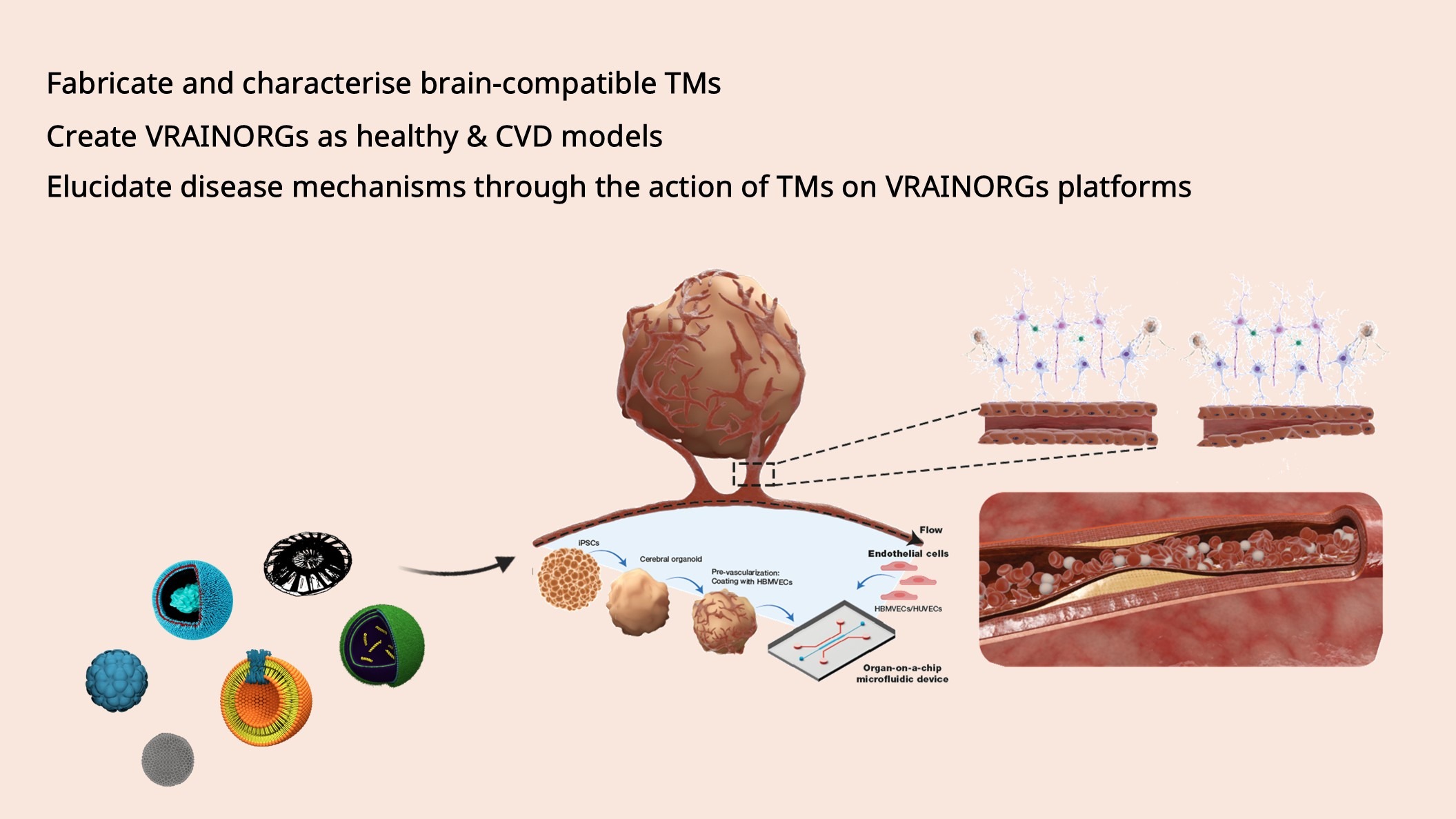
CMT-DN will train 14 Doctoral Candidates (DCs) in the state-of-the art of Tiny Machines (TMs) and Vascularized brAIN (ORGanoids)-on-chip models (VRAINORGs) for CerebroVascular Diseases (CVDs)

CMT-DN RESEARCH OBJECTIVES

CONSORTIUM

Projects

Project Details

Each CMT-DN project will be guided by: a primary supervisor (host institution) + interdisciplinary co-supervisor(s) + intersectoral secondment co-supervisor(s) (partner institutions).

CMT-DN includes mandatory industry secondments for all DCs and project-specific virtual interactions with all consortium members

Host institution: University of Galway

PhD enrolment: University of Galway

Project objectives:

O1: To synthesize a MOFs using optimal conditions (molar ratio of the reactants, solvents, metal sources, and temperature) for tunable porosity;

O2: To identify and characterise the optimal conditions for the MOF activation, entrapment and release of the baseline therapeutic, followed by the intended therapeutic (i.e., vasodilator, neuroprotector);

O3: To investigate the effect of the TM1 empty versus therapeutic MOFs (e.g., toxicity, neuronal response, impact on vascularisation) in the VRAINORG 1 platform.

Secondment: Microfluidic Innovation Centre 

Primary supervisor: Dr. Constantina Papatriantafyllopoulou (University of Galway)

Co-supervisors: Prof. Nico Bruns (Technische Universitat Darmstadt), Dr. Lisa Muiznieks (Microfluidic Innovation Centre)

Host institution: University of Galway

PhD enrolment: University of Galway

Project objectives:

O1: To express and purify engineered mechanosensitive ion channels with facilitated valve opening control;

O2: To identify the optimal conditions for the fabrication of mechano-gated polymersomes (via self-assembly of amphiphilic block-copolymers) containing the incorporated engineered mechanosensitive valves and the encapsulation and controlled release of the baseline therapeutic, followed by the intended therapeutic;

O3: To investigate the effect of the TM2 empty versus therapeutic mechanosensitive gated polymersomes in the VRAINORG 1 platform.

Secondment: Microfluidic Innovation Centre

Primary supervisor: Dr. Mihai Lomora (University of Galway)

Co-supervisors: Dr. Siobhan Crilly (University of Galway), Dr. Annalisa Tirella (University of Trento), Dr. Lisa Muiznieks (Microfluidic Innovation Centre)

Host institution: University of Galway 

PhD enrolment: University of Galway

Project objectives:

O1: To culture phytoplankton and isolated carrier scaffolds;

O2:To functionalise the surface of phytoplankton scaffolds with micromotor-activating agent, baseline therapeutic, followed by the intended therapeutic (i.e., vasodilator, neuroprotector);

O3: To investigate the effect of TM3 phytoplankton micromotor with CVP drugs on the designated VRAINORG 3 platform.

Secondment: React4Life

Primary supervisor: Dr. Mihai Lomora (University of Galway)

Co-supervisors: Dr. Siobhan Crilly (University of Galway), Dr. Silvia Scaglione (React4Life)

Host institution: Basque Center for Macromolecular Design and Engineering

PhD enrolment: The University of the Basque Country

Project objectives:

O1: To identify the optimal conditions for the fabrication of LbL capsules based on polyelectrolytes containing baseline therapeutic, followed by the intended therapeutic;

O2:To perform physico-chemical, biocompatibility and release studies to fully characterize the LbL capsules as delivery vehicles for therapeutic agents (i.e., vasodilator, neuroprotector);

O3: To investigate the effect of TM4 polymeric empty versus therapeutic LbL capsules on the designated VRAINORG 1 platform.

Secondment: Microfluidics Innovation Center

Primary supervisor: Prof. Aitor Larrañaga (Basque Center for Macromolecular Design and Engineering, The University of the Basque Country);

Co-supervisor: Dr. Maria Valentina Dinu (Petru Poni Institute of Macromolecular Chemistry)

Host institution: Basque Center for Macromolecular Design and Engineering

PhD enrolment: The University of the Basque Country

Project objectives:

O1: To design and fabricate crosslinked nanogels that enable the entrapment and release of cerebro-protective drugs upon triggering conditions;

O2: To characterize the drug protective nature, the entrapment and release of nanogels as delivery nanocarriers containing baseline therapeutic, followed by the intended therapeutic;

O3: To investigate the effect of TM5 polymeric nanogels on the designated VRAINORG 1 platform.

Secondment: Microfluidics Innovation Center

Primary supervisors: Prof. Marcelo Calderón, Dr. Ana Beloqui (Basque Center for Macromolecular Design and Engineering)

Co-supervisors: Dr. Mihai Lomora (University of Galway), Dr. Lisa Muiznieks (Microfluidics Innovation Center)

Host institution: University of Trento

PhD enrolment: University of Trento

Project objectives:

O1: To design and fabricate nano/micro hydrogels that enable the capture and release of brain-therapeutics upon triggering conditions;

O2: To characterize the hydrogels as delivery nano/micro-carriers for baseline therapeutic, followed by the intended therapeutic (i.e., vasodilator, neuroprotector);

O3: To investigate the effect of TM6 injectable nano/micro hydrogels (e.g., toxicity, neuronal response, impact on vascularisation) on the designated VRAINORG 5 platform.

Secondment: ibidi

Primary supervisors: Dr. Annalisa Tirella, Dr. Luca Tiberi (University of Trento)

Co-supervisors: Dr. Siobhan Crilly, Dr. Mihai Lomora (University of Galway), Dr. Zeno Guttenberg (ibidi)

Host institution: Petru Poni Institute of Macromolecular Chemistry

PhD enrolment: Petru Poni Institute of Macromolecular Chemistry

Project objectives:

O1: To fabricate a biopolymer-based NMG for the incorporation of a brain-related therapeutic;

O2: To perform physico-chemical and biocompatibility characterisation of NMG therapeutics for baseline therapeutic, followed by the intended therapeutic;

O3: To assess the performance of the TM7 brain-related NMG-therapeutic in the VRAINORG 1 model.

Secondment: Microfluidic Innovation Centre 

Primary supervisor: Dr. Maria Valentina Dinu (Petru Poni Institute of Macromolecular Chemistry)

Co-supervisors: Dr. Mihai Lomora (University of Galway), Dr. Lisa Muiznieks (Microfluidics Innovation Center)

Host institution: Technical University of Darmstadt

PhD enrolment: Technical University of Darmstadt

Project objectives:

O1: To synthesise and functionalise block copolymers for added intrinsic mechanical properties;

O2: To design a shear-activated nanoreactor capable of local synthesis of baseline therapeutic, followed by the intended therapeutic (i.e., vasodilator, neuroprotector);

O3: To investigate the effect of TM8 nanoreactor on the designated VRAINORG 2 platform.

Secondment: Mimetas

Primary supervisor: Prof. Nico Bruns (Technical University of Darmstadt)

Co-supervisors: Dr. Aitor Larrañaga (Basque Center for Macromolecular Design and Engineering), Dr. Nienke Wevers (Mimetas)

Host institution: Microfluidics Innovation Center

PhD enrolment: University of Galway

Project objectives:

O1: Design and construct a platform for vascularised brain cell perfusion, considering the properties of brain cells (requirement of low shear stress, oxygen levels and pH of culture medium);

O2: Include sensors for oxygen and pH measurements for real-time monitoring of culture conditions;

O3: Test and validate system with cell culture / pre-developed brain organoids;

O4: Use VRAINORG 1 to test TM1 & assess potential new findings from other workpackages.

Secondment: University of Galway

Primary supervisor: Dr. Lisa Muiznieks (Microfluidics Innovation Center)

Co-supervisors: Dr. Aitor Larrañaga (Basque Center for Macromolecular Design and Engineering), Dr. Mihai Lomora (University of Galway)

Host institution: Mimetas

PhD enrolment: Amsterdam University Medical Center

Project objectives:

O1: Develop and characterize 3D neurovascular unit on-a-chip models comprising brain microvascular endothelial cells, astrocytes, neurons, and immune cells in the OrganoPlate®;

O2: Model cerebrovascular pathologies, e.g. modelling ischemic stroke using oxygen/glucose deprivation techniques or modelling neuroinflammation using cytokines;

O3: Develop and validate assays to assess effects of cerebrovascular pathologies in the neurovascular unit on-a-chip model (immunostaining, PCR, ATP production, production of reactive oxygen species, mitochondrial assays, immune cell adhesion/migration);

O4: Use VRAINORG 2 to test TM2 & assess potential new findings from other workpackages.

Secondment: VUmc, GAL

Primary supervisor: Dr. Nico Wevers (Mimetas)

Co-supervisors: Prof. Nico Bruns (Technical University of Darmstadt), Prof. Helga de Vries (Amsterdam University Medical Center), Dr. Mihai Lomora (University of Galway)  

Host institution: React4Life

PhD enrolment: University of Milano-Bicocca 

Project objectives:

O1: Develop and characterize 3D neurovascular unit on-a-chip models comprising brain microvascular endothelial cells, astrocytes, neurons, and circulating immune cells in the MIVO® OOC;

O2: Model neuroinflammation using cytokines and immune cells infiltration and interplay;

O3: Develop and validate assays to assess effects of cerebrovascular pathologies in the neurovascular unit on-a-chip model (immunostaining, PCR, ATP production, production of reactive oxygen species, mitochondrial assays, immune cell adhesion/migration);

O4: Use VRAINORG 3 to test TM1 & assess potential new findings from other workpackages.

Secondment: University of Galway, University of Milano-Bicocca

Primary supervisor: Dr. Silvia Scaglione (React4Life)

Co-supervisors: Dr. Maria Valentina Dinu (Petru Poni Institute of Macromolecular Chemistry), Dr. Mihai Lomora (University of Galway), Prof. Laura Cipolla (University of Milano-Bicocca)  

Host institution: University of Trento

PhD enrolment: University of Trento

Project objectives:

O1: Develop and characterize in-house 3D brain models with vasculature; 

O2: Model neuroinflammation using cytokines and immune cells infiltration and interplay;

O3: Develop and validate assays to assess effects of cerebrovascular pathologies in the 3D vascularised brain models (immunostaining, PCR, ATP production, production of reactive oxygen species, mitochondrial assays, immune cell adhesion/migration);

O4: Use VRAINORG 4 to test TM1 & assess potential new findings from other workpackages.

Secondment: ibdi, University of Galway

Primary supervisors: Dr. Luca Tiberi, Dr. Annalisa Tirella (University of Trento)

Co-supervisors: Dr. Siobhan Crilly, Dr. Mihai Lomora (University of Galway), Dr. Zeno Guttenberg (ibidi)

Host institution: ibidi

PhD enrolment: Technical University of Darmstadt

Project objectives:

O1: Develop and characterize a brain-on-chip 3D model with vasculature using the ibidi® chip platform technology;

O2: Model neuroinflammation using cytokines and immune cells infiltration and interplay;

O3: Develop and validate assays to assess effects of cerebrovascular pathologies ibidi® chip developed platform (immunostaining, PCR, ATP production, production of reactive oxygen species, mitochondrial assays, immune cell adhesion/migration);

O4: Use VRAINORG 5 to test TM3 and assess potential new findings from other workpackages.

Secondment: University of Galway

Primary supervisor: Dr. Zeno Guttenberg (ibidi)

Co-supervisors: Dr. Annalisa Tirella (University of Trento), Dr. Mihai Lomora & Dr. Siobhan Crilly (University of Galway)

Host institution: University of Galway 

PhD enrolment: University of Galway 

Project objectives:

O1: Develop and characterize 3D neurovascular unit on-a-chip models comprising brain microvascular endothelial cells, astrocytes, neurons, and circulating immune cells in the custom ibidi® chip;

O2: Model neuroinflammation using cytokines and immune cells infiltration and interplay;

O3: Develop and validate assays to assess effects of cerebrovascular pathologies in the neurovascular unit on-a-chip model (immunostaining, PCR, ATP production, production of reactive oxygen species, mitochondrial assays, immune cell adhesion/migration);

O4: Use VRAINORG 6 to test TM1 & assess potential new findings from other workpackages.

Secondment: ibidi, University of Galway

Primary supervisor: Dr. Mihai Lomora (University of Galway)

Co-supervisors: Dr. Luca Tiberi (University of Trento), Dr. Zeno Guttenberg (ibidi), Dr. Constantina Papatriantafyllopoulou (University of Galway) 

Eligibility

Eligibility check

Before applying, please check your eligibility. Eligible fellows must:

Mobility rule: Fellows must not have resided or carried out their main activity (work, studies, etc.) in the country of the recruiting institution (beneficiary) for more than 12 months in the 36 months immediately before their recruitment date. 

Recruited fellows can be of any nationality.

You must be a Doctoral candidate, which means you must not already be in possession of a doctoral degree at the date of recruitment.  

Following recruitment, you must be enrolled in a doctoral programme at the PhD-awarding institution for the specific project. Please refer to the individual project listings for further details.

START YOUR PhD JOURNEY WITH CMT-DN

START YOUR PhD JOURNEY WITH CMT-DN

START YOUR PhD JOURNEY WITH CMT-DN

START YOUR PhD JOURNEY WITH CMT-DN

START YOUR PhD JOURNEY WITH CMT-DN

START YOUR PhD JOURNEY WITH CMT-DN

START YOUR PhD JOURNEY WITH CMT-DN

START YOUR PhD JOURNEY WITH CMT-DN

START YOUR PhD JOURNEY WITH CMT-DN

START YOUR PhD JOURNEY WITH CMT-DN

START YOUR PhD JOURNEY WITH CMT-DN

START YOUR PhD JOURNEY WITH CMT-DN

START YOUR PhD JOURNEY WITH CMT-DN

Contact

Contact

Any questions?

[contact-form-7 id="17831"]

This project has received funding from the European Union’s Horizon Europe research and innovation programme under the Marie Skłodowska-Curie grant agreement ID: 101227628.

CMT-DN@universityofgalway.ie


The views and opinions expressed are solely those of the author(s) and do not necessarily represent those of the European Union or the European Research Executive Agency (REA). The European Union and the granting authority accept no responsibility for any use that may be made of this information.

© 2026 CMT-DN. All right reserved. Created using the RavexTheme